Wednesday, 4 December 2013

Ireland and the First Nations Education Act

Dingle Peninsula
A number of years ago, I went on a cycling tour of the Dingle peninsula in western Ireland.  Dingle is located just north of the famous Ring of Kerry.  It is similar to Kerry but it doesn't have the traffic so it's ideal for bicycling.

It was breathtakingly beautiful. There were high meadows of flowers and a singing landscape of brooks at Conor Pass, the highest point in Ireland. Roads that clung to the side of seaside cliffs reminded me of the Cabot Trail of Nova Scotia. And everywhere were roadside hedges meters thick from centuries of growth and covered in the shocking pink vines of wild fuchsia.  My trip ended at Killarney National Park, one of the few forests remaining in Ireland.  I could almost see the Leprechauns in the wonderful tapestry of green that is Killarney.

A clochaun in Dingle
Woven into this landscape is the presence of a long history that includes the use of stone to build many meandering kilometers of dry stone fence. Here is a picture of a stone clochaun.  It is dug somewhat into the earth and it was surprisingly spacious inside.  I appreciated it's dryness and I'm sure the Celts living there did too as it rains every day along the coast.  Dry stone masonry doesn't use any mortar to cement the stone together. Rather it all stays together because each stone is chosen to fit like a piece in a jigsaw puzzle.  This clochaun has stood for about 900 years!

Fitzgerald's Pub, Castlegregory
History dogged me throughout the trip.  I went to Ireland hoping to find some descendants of distant relatives as my father's family came from Ireland. FitzGerald isn't a very common name here but over there, it's the equivalent of Smith.  There was a FitzGerald grocery store, a FitzGerald tavern and hardware, and FitzGeralds filled the cemeteries so my search was a lost cause.

But what I lost in terms of family history, I gained in terms of historical perspective.  As I sped down a very steep hill into the town of Dingle, I passed a sign advertising the Dingle Music Festival.  Yes, it is indeed possible to speed down a long escarpment on a fully loaded bicycle and possible too to get a flat tire.  Still as luck would have it, I was in time to hear the last evening of the festival and miracle-of-miracles, able to get a ticket. The Dingle Music Festival is far better known now and if you do go, don't take a chance on last-minute tickets.

Mary Black is well-known today but back then, she was popular only with the good people of Ireland. Mary sang both upbeat songs and dirges, laments expressing grief.  I remember one that spoke about young people who boarded boats never to return. Towns of young people, never returning. Generations effectively gone and lost to the typhus of the boats before the advent of a modern postal system allowed for continuing contact. For Mary and her compatriots, all this happened yesterday.  The Irish are still mourning young people lost centuries ago.

Afterward I spoke to Mary and explained that as an Irish descendant in Canada, I didn't have this sense of history.  My father told me that boarding that boat was the smartest thing his great-grandfather had done.  Mary told me about towns that held funerals for the young people embarking on those ships and how the dirges came from those many and constant funerals.

It became clear in the course of our short conversation that Mary and I had very different views of history. Her view was very long and detailed spanning many generations.  Mine was short and mostly unknown as both my father's parents died while he was a child.  I gave a little prayer of thanks to my unknown ancestors who had taken such risks to come to Canada.

As I listened to Trustee Peter Garrow speak about the Aboriginal significance of seven generations at the Ontario Public School Boards Association board of directors meeting this weekend, I thought of Mary. The board of directors is made up of thoughtful, caring trustees from around the province and it is a privilege to work with them.  Besides, I have an audience who seems to enjoy my terrible jokes.

Peter is of the Mohawk Nation Bear Clan, lives in Cornwall, and he teaches Aboriginal history.  As Peter explains it, when he was born, his great-grandfather was still alive. Peter hopes to live to see his great-grandchild.  This is the significance of seven generations, the generations a person can hope to know in a lifetime.  Like Mary, First Nations people think in the longer term.

As I heard Peter explain the new First Nations Education Act, I was appalled.  After advocating for Aboriginal education funding in an earlier post, the phrase that sprang to mind was be careful what you wish for.  I mean how is it that the government of Canadians, Canadians who pride ourselves on a sense of fairness, can impose such a system on Aboriginal peoples without consultation?  How can it be that the government provides less funding for children's education on reserves?  How is it that our government can require a set of educational standards that has little to do with First Nations, Inuit and Metis reality? And even after issuing the historic apology for residential schools, is this yet another attempt to assimilate Aboriginal peoples?

During my cycling trip to Ireland, I realized that I have less in common with the old than the new world. I am proud of our Canadian culture with it's many Aboriginal traditions that include town hall meetings and participatory democracy.  I recognize I live on Algonquin lands and am thankful to live in this beautiful country.  At 11 am on December 10, I will be joining with many others at Victoria Island to protest the government's First Nations Education Act.  Please join me.


The views expressed in this post are personal opinions only.

P.S. Every story needs some comic relief.  The background to this is that Tour de France teams were training in Ireland.  So without further ado, here is a pseudo-limerick (the meter isn't right) written in Limerick:
There was an old woman on bike
Less often would cycle than hike
Herself out of Limerick,
Passed by every young Tim or Dick
And even a Harry on trike. 


Sunday, 1 December 2013

Men, women, and the expression of love

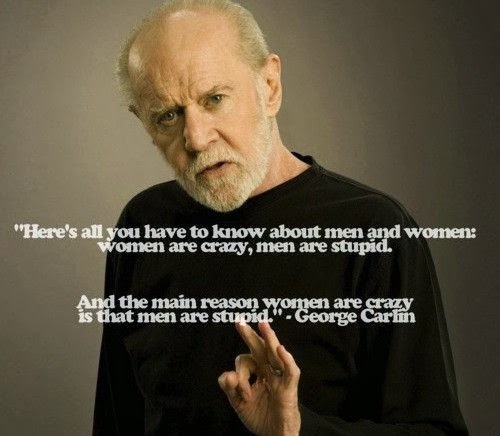
I have so many ideas today that I could probably write three posts at once.  But if I tried, you would know that I'm crazy rather than merely suspecting it. Speaking of crazy, here's a quote from the great and irreverent George Carlin to help set the mood:
"Here's all you have to know about men and women: women are crazy; men are stupid. And the main reason women are crazy is that men are stupid."
Venus and Mars habitation aside, men and women express emotions differently.  I won't try to give some half-baked rationale for this except to say that like Carlin, I've generally observed it to be true. While it's a great source of consternation between the sexes, perhaps it's really about love and how it's expressed.

I love cartoons.  Some get to the nub of complex ideas with a few simple panels.  I've probably learned much of what I know from such fine cartoonists as GB Trudeau, Bill Watterson and Lynn Johnston.

Lynn Johnston in For Better or For Worse illustrates how women often think men express emotions.  But ladies, just because you don't hear male expression of emotion, doesn't mean it doesn't exist!

Expressing emotion is fundamentally about trust and we express trust and love in different ways.  For women, it's generally about opening up and making an effort to put feelings into words.  It's about trusting the other person, usually a woman, to listen sympathetically without rushing to judgement.  Your best girl friend is the one who is there to listen and provide encouragement, mostly uncritical encouragement.

For men, it's different.  A male friend sent me this:
"Men socialize by insulting each other, but they don't really mean it.  Women socialize by complimenting each other, and they don't really mean it either."
I couldn't find the author of this quote.  While we all know it isn't entirely true, still it has a ring of truth to it. Men show affection by razzing each other.  Remember this is coming from a woman so don't take my word for it but I think it's a comfortable way for men to show affection.  It's like saying "I love you." but without the mushy words.

Many years ago, my father and I went Christmas shopping and we stopped for a drink afterward.  Over the beer that marked a change in our relationship to that of friends, he said to me, "You know, parents try to do what's right for their kids but they don't always get it right."

Young and female though I was, I understood that while my father wasn't being emotive, he was in a very real sense apologizing.  I tried to spare his dignity and replied, "Well most kids eventually understand that parents act out of love."  And that was that.  No long ruminating.  No further explanations required.

So for the adult kids out there, take the time this holiday season to tell your dad you love him .  Just don't expect mushy words in return.


The views expressed in this post are personal opinions only.

Thursday, 28 November 2013

Disability and the two wise men

Those we most often exclude from the normal life of society, people with disabilities, have profound lessons to teach us.”  Jean Vanier, Becoming Human
There can be an overlap between disability and mental health when the years of dealing with mental, physical or learning challenges take a toll on a child. Nothing prepares you for your child's first crisis. Like glass shattering around you, you find out everything you've taken for granted is as fragile as fine crystal. 

Your daughter somehow finds a bottle of sleeping pills and is now unresponsive. You find the strength to drive her to the hospital where she regains consciousness but you are told that she won't be assessed.  After a number of attempts with similar hospital outcomes, you finally realize that for your child's safety, you will have to call the police. And you think there can be nothing so heart-breaking as watching the police take away your child.

Nothing, that is, until you talk to Amanda Telford.  Some of you may remember Amanda from the headlines last spring when for her son's safety, she left 20-year-old Philippe in the care of a social service agency. Philippe has developmental delays and autism.  He has Tourette syndrome and because of this, he flicks his wrists in a manner that others find off-putting.  He is a runner and has run into traffic.  Philippe also has adult-onset diabetes that require daily insulin injections and because of his complex needs, the Telfords had trouble finding respite care for Philippe.  For years, they took turns sleeping and working in shifts, never leaving Philippe unattended.

The Telfords played the game by all the rules to find care for Philippe.  They contacted appropriate social service agencies to simply request a little respite care.  They were then promised meetings with agencies that didn't materialize.  They contacted their provincial and federal representatives and were told to wait their turn ... on a waiting list with 568 other families at that time.  A few years ago, there were two hundred adults waiting for residential services in Eastern Ontario.  Now there are now 931. Two years ago, 13 adults were placed in residential care.  Last year, there were 3 placements!  When Amanda's health started to fail, she couldn't wait any longer.

We are often told the aging population will create a crisis for medical and social service agencies and a financial crisis for the next generation.  But there is some truth to an editorial in the December 2012 edition of Zoomer Canada where Moses Znaimer says that the Boomer generation is the one holding it together financially for the Millennials both in terms of continuing to house them well into their twenties while holding vast amounts of equity in their homes that many Millennials will eventually inherit.  Many Boomers who do survive to be 90 or 100 will have that home equity to see them through and even if junior doesn't inherit the house, mom or dad Boomer are less likely to be a drain on the public purse than prognosticators of the "grey tsunami" would have us believe.

On the other hand, there are great numbers of children with autism and other special needs who are coming of age.  What will become of this tidal wave of children with exceptional needs as they mature?  To my mind, this is the real crisis.

As parents of exceptional children age, we worry about who will be there to care and support our children when we no longer can.  We go to great lengths to set up wills with Henson Trusts, the only vehicle available to ensure that our children's needs will be met. We scrape together whatever we can deposit in Registered Disability Savings Plans, the RRSP equivalent for people with special needs.  And these will just provide basics for our children.

Governments closed institutions in Canada for humane reasons or so we were told.  But it is definitely not humane if the only alternative to institutional care is to live in an elderly parent's home or on the street. Canadian governments haven't funded nearly enough group home spaces to begin to meet the growing need. And as thousands wait in line for a residential space, Amanda is asked the heart-wrenching question once again, "Will you take your son home now?"  And somehow every month or so, she has to find the strength to advocate for her son while continuing to say no.  What will happen to Philippe when Amanda is no longer there to watch out for him?  What will happen to the thousands of Philippes?
It's interesting to note how different religious leaders often reach similar conclusions. Jean Vanier is a deeply religious Catholic and Mahatma Ghandi was a devout Hindu.  I'll finish with a last quote from Ghandi:

"A nation's greatness is measured by how it treats its weakest members."

Don't look at the elderly as the threat to civil society when the real danger comes from shards of glass beneath our feet.


The views expressed in this post are personal opinions only.

Thursday, 21 November 2013

The making of a politician

Running for public office can be daunting.  Putting yourself and your views out for public scrutiny is scary.  I suppose this has always been the case but it is particularly so since the advent of the internet.  Good people who run in an election need a thick skin and your encouragement.  As I wrote in an earlier post, most people should be encouraged.   They run for office for good and caring reasons.  But what happens to these good people after they become politicians?

About 8 years ago before I became a school trustee, I attended an education conference in Toronto.  It might have been the annual People for Education conference, which I highly recommend, or an event sponsored by The Learning Partnership.   The important feature was that it brought together different people interested in education under one roof.

I remember two moments from that conference.  The first was that a trustee from another school board encouraged me to run for office.  Her gesture was very kind and meant a lot to me, although there have been a few days since when I was more likely to curse than thank her.  This trustee and I became good friends and although politics can be hard, I have no regrets about running.

The other part I remember is hearing an older trustee speak on a panel.  This gentleman was well on in age and he said something that I found rather peculiar.  He said that in his school board, the board meetings are scheduled on the same evenings as the school council meetings.  Why?  Because school trustees didn't want to hear or didn't want to know parents' complaints.  He felt that if he heard some parents first-hand, it would influence his decision-making ability in the boardroom.

At the time, this struck me as rather strange.  Why wouldn't a politician want to keep in touch with his constituents?  Why wouldn't a person responsible for governing an institution want to hear complaints?  Why would a thoughtful man want to keep himself ignorant?  Now I understand a little better.

The use of various mechanisms within political practice, such as plausible deniability, creates a win-win situation for politicians and bureaucrats.  It's not just staff in a school board, city hall or legislature who want to keep politicians in the dark; many politicians want this too.  It works for both sides and the "good politician" who is willing to play the game, soon learns not to make waves and not to ask certain questions.

I was given advice by a veteran politician shortly after I became a trustee.  It was, "Play ball with staff.  Defer to staff."  Sadly for me, I suppose, I never got the hang of this and I continue to ask questions.  Perhaps it's arrogance and I delude myself to think that I am a better politician in trying to understand a very complex system.

Even though I'm not one, I have a lot of sympathy for the "good politician."  The system really is so incredibly complicated with a great many traps.  I think most new politicians must feel overwhelmed and many strike an informal deal with their staff - I will not make waves and will support staff initiatives if you support and protect me.  Of course none of this is actually said.  It simply becomes the dynamics of the interaction between the two groups -- an understanding.

At some point, the politician makes a choice.  Although the bureaucracy works to keep politicians in the dark, it's the politician him or herself who makes the decision to stay in the dark.  Through this arrangement, staff  maintains control by limiting contact to the politician.  In return, the politician may get some protection with a bail-out in a difficult situation or perhaps staff assistance with a project that works to the politician's benefit.

Of course all this is used to comedic effect in older TV shows like Yes Minister and we even saw it illustrated on the show the West Wing, where the politician in question was a principled and brilliant president.  The point is that most politicians either learn to play the game or their political party and staff will find ways to ensure they do.

I now have free rein to speak and as a school trustee, I don't need to worry about the influence of a political party.  Still I can assure you that even without the influence of a party, there are mechanisms used to try and silence outspoken politicians though we are learning just this week that they don't always work.

It is an extraordinary politician who can pick his way through this ethical mine field unscathed and we honour those rare politicians, such as Nelson Mandela or Mahatma Gandhi, who do survive.  The winners in this game are not simply those who cling to office. That's easy enough to do.  The real winners are the leaders who inspire us and leave public office with their integrity largely intact.


The views expressed in this post are personal opinions only.

Friday, 8 November 2013

Rob Ford and the unexamined life

I love conversations with my son.  It's a routine we fell into many years ago as we watched tree bats at sunset swoop overhead or walked in an early morning rain.  Over time, it became outings to Chapters with conversations over coffee.  Now we just seem to fall into the routine anytime we can.  It's a great gift!

My fondest memories of my late father involve walking and talking too -- over a long bridge in the winter cold for the joy of a hot chocolate on the other side or on a beach at dawn in search of sand dollars. Those were the times my father would impart parental pearls of wisdom or ask, "If all your friends jumped off a bridge, would you jump too?". But what I remember most are the stories my father told me about his life.

My dad saw the world as larger than himself.  Orphaned as a child, he cherished the notion of family as part of that bigger, more important world he believed in.  Through his beliefs and principles, my father knew who he was.  He had integrity and he wanted his children to grow into principled adults too.

What is a good parent?  Although putting a roof over children's heads is important, being a good parent is not about buying things. Nor is it about living in the best neighbourhoods or enrolling children in the best schools.  And it's not just about throwing a football around, though that's good to do too.  It's about spending real time rather than simply quality time with your child.  It's about talking with your child.  And about something we can all do -- listening to our children.

The funny thing is that the listening part is probably the most important aspect.  By listening to your child, you validate her as human being.  You communicate that he has something worthwhile to say.  And if you have the patience to listen, really listen, you may find that your child does indeed have something valuable to say, occasionally something even brilliant.  Out of the mouths of babes come honest observations unfettered by convention.

Well, I promised a tie-in with our cause célèbre of the week, Rob Ford.  What I see in Rob Ford is a man sadly without integrity, someone without a larger world of principles or beliefs. As is revealed in the latest video, a man who lives in the very small lonely world for himself and himself alone, without larger purpose. Little wonder he turns to alcohol and crack in his loneliness.

Though an extreme example, Rob Ford is a product of our time.  When few people have time to make sense of the world or even have time for a conversation, when people are inundated with senseless information devoid of meaning, when they are alienated and feel powerless to control their destinies, and when change is happening at an increasingly faster rate, almost everyone is left floundering.  'Whatever', the universal cry of youth, then becomes the norm.

If I were to have had this conversation 2,400 years ago with the philosopher Socrates, he might have responded, "The unexamined life is not worth living." Slow down and find out who you are. Take time to know yourself.

This seems an especially good maxim for politicians to follow. As Andrew Coyne said on The National, "There's been longstanding problems of a lack of an accountability mechanism. We've relied a lot on decent chaps running things. And when decent chaps aren't decent chaps or aren't running things, we've run into difficulties."  To which I might respond, well south-of-the-border, they've seen the result of the other extreme with too many checks and balances. They now have a political system that is shut down with gridlock.  Right now, neither the Canadian nor the American system seems to be working very well.

All I can do in life, all anyone can do, is moderate my own behaviour.  To do this well, I have to be introspective and act with integrity, accepting my mistakes and learning from them.  Reflection takes time though but with it, the old-fashioned words of principle and integrity can take on new meaning.  All we really need to do is slow down and listen to that inner voice; just slow down.  It doesn't really matter where you begin but a walk with your child this weekend would be a good place to start.


P.S.  Last weekend, I had the pleasure of meeting a regular reader of this blog who was kind enough to come over and introduce himself.  Thank you.  If you ever find yourself in the same room with me, please don't be shy. Come over and say hello.


The views expressed in this post are personal opinions only.

Thursday, 17 October 2013

Let's make amends for residential schools

Five years ago, I went on a cruise in the North. I have seen much of this wonderful country but like most Canadians, I had never been up North. I know this sounds extravagant but in my defense, a cruise is the only way to see much of it.  The voyage was from Reykjavik Iceland, which is wonderful, around the tip of Greenland, on to Nunavut including a stop in Iqaluit, and then down the coast of Labrador to St. John's, Newfoundland.  
Qaqortoq, Greenland
The North is so beautiful and it's all it's cracked up to be. There are thundering glaciers, shimmering Northern Lights, landscapes covered in flowers, and beautiful friendly children.  Here's a picture of some students in Qaqortoq, Greenland. Look at the town behind them.  The homes are freshly painted and you might not spot them but there's a school and a hospital too.  It was a different story in Labrador.  In the towns where we stopped, I saw buildings that were generally in poor repair and children who were high.

The stark contrast between these communities left me with real questions. The people of the Greenland and Labrador communities are of similar backgrounds and culture. So why is it that a relatively small country like Denmark can appear to get it right while a wealthy country like Canada gets it so wrong?  I have given this some thought over time and it seems that the answer boils down to a difference in the histories.  From what I've read of Greenland's history, it never had residential schools.

Handcuffs used on Native American school children
Let's look at the question of residential schools for a moment because there can often be some confusion.  While residential schools were boarding schools, they were also designed to assimilate Aboriginal children. Residential schools were first opened in 1831 and the last one was closed in 1996. Unlike boarding schools, children as young as four years of age were forcibly sent to live continuously at residential schools often for many years at a time.

A school is supposed to be a refuge for children but students in residential schools were forbidden from speaking their language and practicing their traditions. Hundreds of miles away from home and without a means of travel, many students did not see their families for years.  And we all know about the abuse including sexual abuse that happened in these schools.  I have had the honour of speaking to survivors of residential schools. When I hear the stories, I cannot help but cry for their pain.  How can it be in a country like Canada that these schools were allowed to become something akin to prisons for so many little children?   

Yesterday, I listened to the Speech from the Throne.  There were 133 references to "our government" in the speech.  I counted them.  

In 2008, Prime Minister Stephen Harper apologized to the survivors of residential schools. Maybe I'm old fashioned but I believe that when you genuinely apologize, you also try to make amends. Towards this end, I had hoped to hear in the Throne Speech something about a new government initiative for educating children on reserves.  Instead I heard this:
Our Government recognizes the tremendous potential of Canada’s First Nations, Métis and Inuit populations to strengthen the growing Canadian economy. It will continue working with First Nations to develop stronger, more effective, and more accountable on-reserve education systems. 
Does this sound like a new initiative to you?  And doesn't it strike you as rather odd that "our government" would honour Malala Yousafzai, who is rightly deserving of honour for her heroic efforts in support of education, while ignoring the educational needs of students here at home?

There is an ongoing legacy from these schools that will haunt First Nations and Inuit people for generations. At the impressionable age of 4, Aboriginal children were robbed of their language and culture, robbed of good parenting role models and love, and ultimately robbed of their childhoods.  And with the poverty that surrounds many reserve communities today, how can these children who are now adults hope to raise healthy children?

Governor General Johnston, I am one of your many proud Canadians.  But when I think about the history of the residential schools, I am filled with a deep sense of shame.  It is time for this government to make good on its apology.


For more information about residential schools, go to The Legacy of Hope Foundation or to the Truth and Reconciliation Commission.

The views expressed in this post are personal opinions only.


Thursday, 10 October 2013

The wisdom of Malala

What can be said to today's youth by way of advice about the future?  There's little -- it's unknowable and everything changes so rapidly.  There are no reliable trends and few traditions to depend on.  But then this week I came upon Daniel Pink's The Adventures of Johnny Bunko.  It's in a cartoon format and I highly recommend it to all guidance teachers.  While Pink doesn't claim to know the future, he does lay out some guidelines for youth that make sense:
  1. There is no plan.
  2. Think strengths, not weaknesses.
  3. It's not about you.
  4. Persistence trumps talent.
  5. Make excellent mistakes.
  6. Leave an imprint.
As I listened to a very moving interview this week with Malala Yousafzai, I couldn't help but think that Malala is familiar with Pink's work. Of course she couldn't be but how is it then that a 16-year-old girl can be so wise?

Truth be told, I wasn't just very moved by this interview.  I was moved to tears. Even Jon Stewart held his breath as Malala responded to the question of what she would do if she met her Taliban attacker.  I can't do justice to her words but Malala said that she thought about hitting her attacker with her shoe but then realized this would make her no different from him.  Clearly showing that she had reflected on this subject deeply, Malala ends with an answer to the effect that she would tell him to shoot but to listen to her first.

How can Malala know about Gandhian principles?  How is it that someone so young can be so wise?  Then I am brought back to earth by a 16-year-old giggle.

"There is no plan." according to Pink.  Right.  So how does one live one's life?  Do we have to live during the Elizabethan era or be part of the civil rights movement to make a difference?  And what if there isn't an era or a movement to hang your hat on.  What do you do to make a meaningful life?

You do what Malala did.  If the police and politicians aren't acting to right wrongs, you speak up for what's right and you carry on with your life.  Malala and her girlfriends continued to go to school each day.  These girls continued to do what they believed was right even when 400 schools were bombed by the Taliban in the Swat Valley. And from what I heard in the interview, some of the girls like Malala knew their lives were in danger but they didn't dwell on it.  They just got up each morning and went to school.  How powerful is that?

Of course it truly is and Malala knows it.  To the question, "Where did your love of education come from?" Malala responds, "We are human beings and this is the part of our human nature.  We don't learn the importance of anything until it is snatched from our hands.  And in Pakistan, when we were stopped from going to school, at that time I realized that education is very important.  And education is the power for women and that's why the terrorists are afraid of education.  They do not want women to get education because then women will become more powerful."

To echo Jon Stewart's response, exactly!  What is it about education, particularly for girls, that makes it so powerful?  There's a lovely video that helps explain this well -- The Girl Effect, The Clock is Ticking.

It's about more than keeping girls safe in school.  For almost all children, school is their only path to literacy and with literacy, children can learn empathy.  They can read books about teens, in my day it was Catcher in the Rye, learn that their lives are not so different, and feel not quite so alone.  Through reading, they can know other lives and see other possibilities.  They can understand that the lives they live at that moment are not predetermined by fate nor by the authorities.  They can dream other futures.

Through art, students learn about their own creativity and the possibilities for transforming this into talent. With mathematical skills, they can turn these talents into successful businesses that can feed themselves and their families.  And with knowledge of science and health, they can begin to understand that they have some mastery over nature and over their own bodies and then use this to keep themselves and their children healthy.

All children can gain from these gifts but for girls in particular, an education can give them that all-powerful self-confidence to say no.  In a society that places lesser value on women, and let's face it that's most societies, this self-assurance can make all the difference.  The Taliban, and in some ways they are no worse than many western governments, are simply smart enough to know that they lose power in a society where women can say no.

How is it that a 16-year-old is so wise?  Malala has done a lot of living in her sixteen years.  Although it's unlikely that she has read Daniel Pink's books, Malala has learnt his lessons through first-hand experience and reflection.

When your life is threatened for it, most sane adults would say it's a real mistake to continue going to school. But Malala understands Pink's fifth lesson, the one about having the courage to make excellent mistakes, particularly well.  The day she was shot, a year ago yesterday, Malala did what she would always do.  Malala went to school.


P.S.  Since I wrote this post, Malala Yousafzai received the Nobel Peace Prize! She was also invited to the White House to meet with President Obama.  According to various sources, this is what she said to the President:
I thanked President Obama for the United States' work in supporting education in Pakistan and Afghanistan and for Syrian refugees.  I also expressed my concerns that drone attacks are fuelling terrorism.  Innocent victims are killed in these acts, and they lead to resentment among the Pakistani people.  If we refocus efforts on education it will make a big impact.
What an amazing young woman!  

The views expressed in this post are personal opinions only.